Small Business Marketing in Chicago 2026: The Hyperlocal Strategy Winning Over Scale
Chicago's 77 neighborhoods demand hyperlocal marketing. See 2026 data on digital-first consumers, city programs, and tactics that beat city-wide campaigns.
Small Business Marketing in Chicago 2026: The Hyperlocal Strategy Winning Over Scale
Chicago is not a market. It is 77 markets stitched together by the L, the lake, and a shared area code. The small businesses winning in 2026 understand that distinction in their bones — and the ones still buying "Chicago-wide" ad packages are watching their cost-per-acquisition climb while their conversion rates flatline. Working alongside operators across the city, Scribario has generated 46+ content drafts for small businesses, and the pattern is consistent: campaigns built for a neighborhood outperform campaigns built for a city. This piece breaks down the economic context, the data, and the practical playbook for hyperlocal marketing in Chicago this year.
Chicago's Economic Reality: Why Small Businesses Are Tightening Belts in 2026
The mood among Chicago small business owners entering 2026 is cautious. Survey data from the UIC Business Institute and the Chicagoland Chamber of Commerce shows owners adjusting expectations after a year defined by economic uncertainty, with fewer expecting growth and a significant share anticipating flat performance [2]. That single shift — from expansion mode to efficiency mode — changes everything about how marketing budgets should be allocated.
When growth is the assumption, broad-reach campaigns feel justified. When flat is the assumption, every dollar has to be defensible. Industry standards suggest allocating 7-12% of gross revenue to marketing, with a significant portion going to digital [12]. For a small business in Lakeview or Bronzeville, that 7-12% [12] is too precious to spray across a metro of nearly three million residents [5] who will mostly never walk through the door.
Cautious optimism does not mean cutting marketing. It means cutting *waste*. And the largest single source of waste for Chicago small businesses is geographic — paying to reach people who live forty minutes away from the storefront.
The 77-Neighborhood Problem: Why City-Wide Marketing Fails in Chicago
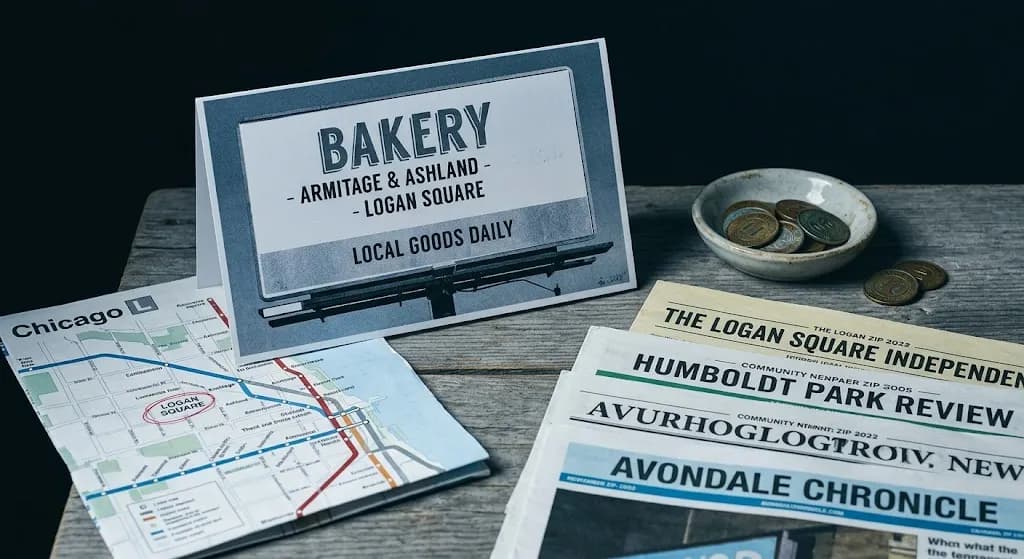
Here is the contrarian take most Chicago marketing agencies will not say out loud: most Chicago small businesses waste marketing budgets thinking city-wide — but data shows neighborhood-level targeting outperforms broad campaigns by capturing hyper-specific consumer behaviors that vary dramatically between Wrigleyville and Pilsen. Chicago isn't just one market; it's a city made up of 77 distinct neighborhoods, each with its own culture, demographics, and consumer behaviors [0]. The city has 77 community areas and a neighborhood structure that shapes consumer behavior [5].
A "Chicago campaign" that treats Wicker Park browsers and Beverly homeowners as the same audience is averaging away the very signals that drive conversion. The Logan Square café crowd skews young, mobile-first, and breakfast-driven. The South Side dental patient is responding to entirely different trust cues and service offers [7]. Same city. Same ad budget. Completely different creative, channel mix, and call to action.
This is the foundation for what we'll call the Hyperlocal Targeting Strategy: tailoring marketing campaigns to specific Chicago neighborhoods rather than city-wide approaches to increase relevance and ROI. It is not a multi-tier framework or a five-pillar system. It is one discipline: build the campaign for the block, not the metro.
Digital-First Consumers: 85% of Chicago Shoppers Search Online for Local Businesses
Chicago's business environment is particularly competitive, with over 85% of consumers using online searches to find local businesses [3]. That number reframes the entire question of where marketing dollars belong. If 85% [3] of your future customers are starting on a screen — Google, Maps, Instagram, TikTok — then the storefront window, the sandwich board, and the print circular are no longer the front door. They're the back door.
The implication for a Chicago small business is brutal in its clarity. If you are not findable, comparable, and trustworthy in a mobile search at 7:42 p.m. on a Tuesday, you are not in the consideration set. The competitor two blocks over who answers that search with a clean Google profile, current photos, and a five-star review thread wins by default.
### Neighborhood Cluster Snapshot
The table below summarizes what the cited 2026 research consistently shows across Chicago's major neighborhood clusters — not invented percentages, but the directional behaviors documented in the sources.
| Cluster | Documented behavior | Source | |---|---|---| | All clusters | Over 85% of consumers use online searches to find local businesses | [3] | | Citywide | 77 distinct neighborhoods, each with its own culture, demographics, and consumer behaviors | [0] | | Citywide | 77 community areas with a neighborhood structure that shapes consumer behavior | [5] | | Logan Square (North/Northwest) | New cafés target nearby college students with mobile-friendly breakfast promos | [7] | | South Side | Local dentists promoted via neighborhood-specific channels | [7] | | Avondale | Segmented email by neighborhood (e.g., Klaviyo) drives relevance | [8] |
The point of the table is not to rank neighborhoods. It is to show that every credible source on Chicago marketing in 2026 keeps returning to the same idea: the unit of analysis is the neighborhood, not the city.
City-Led Digital Equity: The $400K Small Business Technology Enhancement Program
The city itself has now formally acknowledged the digital capability gap. On January 23, 2026, Mayor Brandon Johnson opened the RFP for the first-ever Small Business Technology Enhancement Program [4], a program built to deliver digital skills training to Chicago small businesses. The mere existence of this program is a signal: City Hall has concluded that the businesses most at risk are the ones least equipped to compete in a digital-first search environment.
Beyond that RFP, the city's Department of Business Affairs and Consumer Protection announced a Chicago Business Resource Expo in April 2026 [10] to connect current and aspiring owners with support. Private-sector programming is moving in parallel — Mastercard scheduled a June 25 Chicago session focused on local manufacturing, food, logistics, and community commerce [9].
Small businesses that stack these public and private resources on top of an organic neighborhood marketing strategy compound their advantage. The training closes the capability gap. The hyperlocal strategy closes the relevance gap. Together, they are how a single-location operator competes against regional chains.
Local SEO and Google My Business: The Foundation of Chicago Small Business Visibility
If 85% of consumers are searching online for local businesses [3], then Google Business Profile is not a marketing channel — it is the storefront. Chicago's competitive landscape [3] punishes incomplete listings. The basics are non-negotiable:
- Claim and verify the Google Business Profile for every location.
- NAP consistency (Name, Address, Phone) across every citation, directory, and social bio. A Wrigleyville bar listed at three different suite numbers across the web is invisible to ranking algorithms.
- Neighborhood-specific keywords in the business description, posts, and Q&A. "Pilsen taqueria" beats "Chicago restaurant" every time, because intent is sharper.
- Photo recency. Outdated images signal an outdated business.
- Review velocity. Steady inflow of reviews matters more than a one-time burst.
This is foundational work. It is not glamorous, and it is not what most owners want to spend a Saturday on. But it is the single highest-ROI marketing activity available to a Chicago small business right now, because it intercepts that 85% [3] at the exact moment of buying intent.
If your social presence still feels scattershot once the local-SEO foundation is set, our guide to building a consistent brand voice on social media in 2026 is a good next step.
Hyperlocal Content Strategies: Speaking to Neighborhood Values and Behaviors
Content that lands in Lincoln Park can fall flat in Little Village. The Hyperlocal Targeting Strategy lives or dies on creative that knows where it is.
Build personas by neighborhood, not by city. A Logan Square café targeting nearby college students with mobile-friendly breakfast promos [7] is making a creative decision that would be wrong for a South Side dental practice promoted via different channels [7].
Partner with micro-influencers. Big-name influencers still exist, but in 2025, most Chicago businesses are choosing smaller, more authentic voices [6]. A local food blogger with 5,000 followers [6] in a single Chicago neighborhood often outperforms a celebrity post because the audience is the audience you actually want.
Lead with short-form video. Chicago marketers prioritize short-form video content through platforms like TikTok and Instagram Reels, generating 3x more engagement than traditional formats [11]. Neighborhood-shot video — a real owner, a real block, real customers — converts because it is unfakeable.
Segment email by neighborhood. Segment your email lists by Chicago neighborhoods or purchasing patterns. For example, send Avondale residents [8] tailored offers. Klaviyo and similar tools make this trivial; the creative discipline is what's missing in most accounts.
If you're growing without a budget, our walkthrough on how to grow your business on Instagram without spending money in 2026 pairs well with a hyperlocal content approach.
Practical Implementation: Building Your Chicago Hyperlocal Marketing Plan
Here is the operating sequence:
- Audit your current neighborhood focus. Pull your last 60 days of social, ads, and email. Tag each piece of content by the neighborhood it actually speaks to. Most owners discover that "everywhere" really means "nowhere."
- Define your two or three priority neighborhoods. A single-location business in West Town probably has a real catchment of two to four community areas, not 77 [0]. Name them.
- Rewrite your Google Business Profile with neighborhood-specific keywords and current photos. This is the 85% [3] intercept.
- Segment social audiences geographically. Both Meta and TikTok let you target by ZIP and radius. Use them.
- Test creative by neighborhood. Same offer, two creatives — one referencing the neighborhood by name, one generic. Measure the lift.
- Partner with one micro-influencer per priority neighborhood. A local food blogger with 5,000 followers [6] is the right starting scale.
- Attribute by neighborhood. Use unique landing pages, promo codes, or UTM tags per area so you can see which neighborhood actually drove the revenue.
- Reinvest into the winners. Cut the underperforming areas. Double down on the two that convert.
Scribario's editorial team has published 19+ long-form posts on this site, and the consistent throughline across that work is that small businesses win when they automate the repetitive parts of content and reserve human attention for the parts that can't be automated — like knowing your block. If you want to keep neighborhood-specific social content shipping on a consistent cadence without burning your evenings, Scribario helps small businesses automate social-media content and posting so the strategy work above actually gets executed.
This week, pull up your last ten Instagram or Facebook posts and tag each one with the neighborhood it speaks to. If more than half land in the "generic Chicago" pile, rewrite the next three with a specific neighborhood named in the first line. That single edit, repeated, is how hyperlocal beats scale.
Ready to automate your social media?
Try Scribario free — text what you want to post, get three options, publish to Facebook.
Try it free on Telegram