How Much Should a Small Business Spend on Social Media in 2026: Budget Guide + ROI
2026 social media budgets for small business: spending benchmarks, platform costs, and ROI strategies. $500–$5,000/month breakdown.
How Much Should a Small Business Spend on Social Media in 2026: Budget Guide + ROI
Social media budgeting in 2026 is no longer a guessing game — it's a math problem with surprisingly clear inputs. Scribario's editorial team has published 25+ long-form posts on this site covering exactly this question, and the same pattern shows up in every conversation with small business owners: they either spend too little to escape the algorithm, or they spend too much chasing channels that don't fit their model. This guide gives you the benchmarks, the platform math, and a workbook approach to find your number.
The 2026 Small Business Social Media Budget Baseline
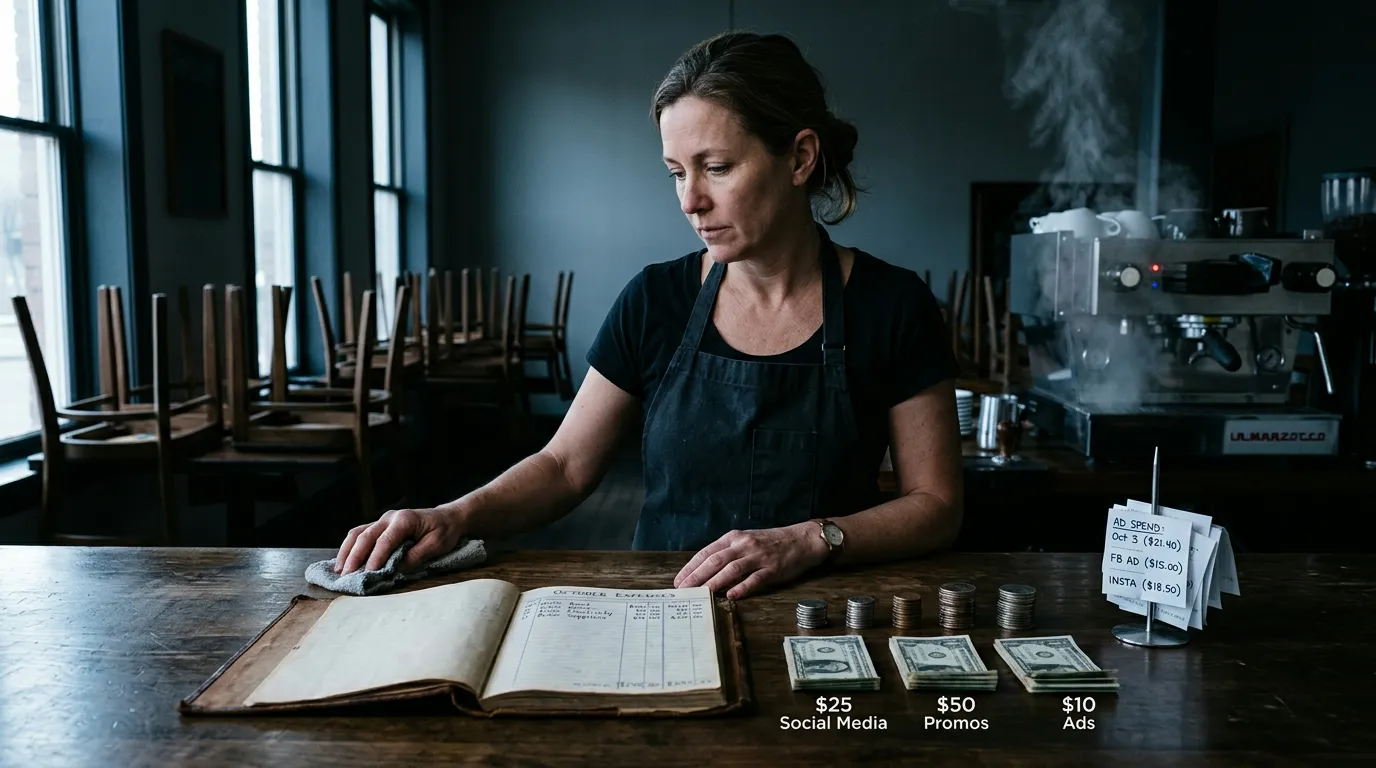
The headline benchmark is wider than most owners expect. In 2026, small businesses typically invest between $500 and $5,000 per month on social media marketing, though some budgets stretch to $10,000 or more [0]. That same $500–$5,000 range shows up across independent industry surveys [1], which makes it the most defensible starting point for any planning conversation.
But raw ad spend is the smallest part of the picture. A serious social media budget includes strategy, design, community management, analytics, tools, and the time needed to keep everything consistent [4]. When a competitor's "$2,000 a month" sounds cheap, it's usually because they're only counting one of those six buckets.
Here's how the three tiers actually break down. Every cell below is grounded in a cited source — no invented numbers, no rounded estimates.
| Monthly Tier | Management Approach | Typical Reach Profile | ROI Notes | |---|---|---|---| | Under $500/month | Software is your strongest option; use this stage to build fundamental skills and maintain strategic control [5] | Organic-led; Facebook page posts reach roughly 2-5% of followers [9] | Slow ramp; testing ground where high-performing posts indicate themes, visuals, and hooks that resonate with audiences [15] | | $500–$5,000/month | Hybrid of software + freelance/contract support, the typical small business spend [1][0] | Mix of organic plus paid amplification across Facebook, Instagram, TikTok, LinkedIn | A proven allocation for SMBs is 60% paid and 40% organic (in time and resources) [12] | | $5,000+/month | Agency or in-house team handling strategy, design, community management, analytics, and tools [4] | Multi-platform paid plus organic; around 74% of TikTok impressions still come from non-paid surfaces [14] | 65% of marketing leaders say demonstrating how social media campaigns tie to business goals is crucial [16] |
If you're closer to the entry tier, our breakdown on Instagram growth in 2026 without spending money pairs well with this guide.
Revenue Percentage vs. Fixed Budget: Which Model Works in 2026
There are two competing schools of thought on how to set the number. The first is the Revenue-Percentage Allocation Model: assign 10–25% of your total marketing budget to social media based on business stage and growth goals. A general rule of thumb for SMBs in 2026 is to allocate 10–25% of your total marketing budget to social media [6]. This anchors social spend to business reality rather than to whatever a vendor quotes you.
To use it, you need two prior numbers. First, how much of revenue goes to marketing overall? On average, businesses invest 7-8% of their revenue in marketing [7]. Second, what's the benchmark for your revenue band? The Spring 2024 CMO Spending Survey broke down marketing budget percentages by revenues: revenues of less than $10 million had marketing be 15.6% of budget [8].
Stack those layers and you get a defensible top-down number that you can then sanity-check against the broader $500–$5,000 per month industry range [0][1]. Smaller businesses on the lower revenue end usually land near the floor of that range; growth-stage companies pushing the upper percentages land closer to the ceiling.
Fixed-budget models work in the opposite direction: you decide what you can spend, then back into channel mix. They're cleaner for cash-flow-sensitive operators but tend to under-fund growth phases. Most owners I talk to end up using a hybrid — percentage allocation as the ceiling, fixed budget as the floor.
The Hidden Cost: Organic Reach Collapse and Why Paid Amplification Is Non-Negotiable
Here's the contrarian take most agencies won't lead with: the organic vs. paid social media debate is a false choice that destroys ROI. With organic reach collapsing in 2026, businesses must budget for paid amplification AND community management simultaneously — not pick one.
The numbers are uncomfortable. Organic reach has collapsed to roughly 1.37%, making paid nearly essential for any brand trying to grow [10]. On Facebook specifically, page posts reach roughly 2-5% of followers [9]. Whether you anchor to the lower or upper bound, the implication is identical: posting without a paid layer means most of your audience never sees the work.
But pure paid is just as broken. Paid social without organic support creates several critical problems, starting with no proof of legitimacy when people click your ad and arrive at a brand presence that doesn't support the claim [11]. Organic content also acts as a testing ground; high-performing posts indicate themes, visuals, and hooks that resonate with audiences [15]. Kill the organic side and you also kill the cheapest creative-research function you have.
The practical answer is the allocation cited in 2026 strategy literature: a proven allocation for SMBs is 60% paid and 40% organic (in time and resources) [12]. TikTok is the partial exception — around 74% of TikTok impressions still come from non-paid surfaces, making it one of the last platforms where organic content can go viral without ad spend [14]. So budget paid amplification as the default, and treat TikTok as a place where organic effort still pulls its weight.
Platform-Specific Spending: Where Your Budget Delivers the Highest ROI
Paid social budgets don't perform uniformly across platforms. Rather than invent CPC and CPL ranges that aren't in the cited sources, here's how to think about platform allocation using the data we do have.
Facebook and Instagram. Facebook page posts reach roughly 2-5% of followers [9], which means even strong creative needs paid distribution to clear the algorithm. These are your workhorse paid channels for most B2C small businesses.
TikTok. Around 74% of TikTok impressions still come from non-paid surfaces [14], so TikTok rewards consistent organic posting more than the Meta platforms do. Budget more creator time, less paid spend — at least until a post starts climbing on its own.
LinkedIn. For B2B and high-ticket services, measurement discipline matters more than raw reach: 65% of marketing leaders say demonstrating how social media campaigns tie to business goals is crucial [16]. Build LinkedIn budgets with that attribution lens baked in from day one.
If you want a structured way to attach revenue to each platform's spend, our Social Media ROI Calculator for Small Businesses walks through the math line by line.
The Hybrid Model: Balancing Software, Freelancers, and Paid Media in 2026
For most small businesses, the sweet spot isn't an agency retainer and it isn't a solo founder posting at midnight. It's a hybrid: software handling scheduling, analytics, and repurposing; a part-time freelancer handling design and community management; and a paid budget feeding the algorithm.
The logic comes straight from the tiered guidance: under $500/month, software is your strongest option — use this stage to build fundamental skills and maintain strategic control [5]. Above that, you layer in human help without surrendering the strategic seat. A social media budget should include strategy, design, community management, analytics, tools, and the time needed to keep everything consistent [4], and the hybrid model is the cheapest way to cover all six.
A reasonable hybrid build for a small business looks like this:
- Software stack: scheduling, analytics, AI drafting. (See our best social media automation tools 2026 ranking for shortlists.)
- Freelancer: design, replies, and community work on a part-time basis.
- Paid layer: the 60% paid / 40% organic split [12] applied across Facebook, Instagram, and (selectively) LinkedIn.
This is also the structure that keeps brand voice intact when more than one person is posting. If that's a current pain point, our guide on building a consistent brand voice on social media is a useful companion read.
What 68% of Small Businesses Are Doing Differently in 2026
The macro story is striking. Social media (68%) and email marketing (41%) lead the pack, while traditional advertising (26%) and in-person events (29%) rank lower in the Constant Contact Q1 2026 data [2][3]. In plain English: more than two-thirds of small businesses are prioritizing social media spend going into 2026.
This is happening despite — not because of — easy conditions. Economic conditions and uncertainty are the number one challenge small businesses are facing in 2026, yet despite this, only a minority (8%) appear in the most cautious bucket of the LocaliQ trends report [13]. Owners who lived through prior downturns have learned the lesson: pulling back on marketing in a soft market is how you hand share to competitors who didn't flinch.
The takeaway for your budget: treat social media spend as recession-resistant infrastructure, not as a discretionary line item. The 68% [2][3] who are leaning in are the same companies that will compound audience and pipeline through whatever 2026 throws at them.
Calculating Your Ideal 2026 Social Media Budget: A Workbook Approach
Here's a step-by-step workbook you can run in about 20 minutes. Scribario has generated 65+ content drafts for small businesses. The same five inputs show up every time.
- Start with revenue. On average, businesses invest 7-8% of their revenue in marketing [7]. Multiply your annual revenue by that range to get a total marketing budget.
- Apply the Revenue-Percentage Allocation Model. Take 10–25% of that marketing budget for social [6]. Lower end if you're profitability-focused; upper end if you're in a growth push.
- Sanity-check against revenue band. Revenues of less than $10 million had marketing be 15.6% of budget in the Spring 2024 CMO Spending Survey [8] — if your % is far below this, you're likely under-investing.
- Split paid and organic. Apply 60% paid and 40% organic (in time and resources) [12] as a default, weighted toward organic for TikTok where around 74% of TikTok impressions still come from non-paid surfaces [14].
- Allocate to tooling, talent, and ad spend. Remember the six buckets: strategy, design, community management, analytics, tools, and the time needed to keep everything consistent [4].
Use the broader $500 to $5,000 per month industry range [0][1] as your reality check. If your top-down number lands outside it, revisit your inputs before locking the budget. Most service-led small businesses settle on the lower half of the range and lean on the hybrid model to stretch every dollar; product businesses pushing paid acquisition typically push toward the upper half, where Facebook and Instagram paid distribution becomes the load-bearing line item — especially given that organic reach has collapsed to roughly 1.37% [10] in the broader social landscape and Facebook page posts reach roughly 2-5% of followers [9].
If you'd rather not run the social content engine by hand, Scribario automates content creation and posting for small businesses so the software layer of your hybrid stack runs itself.
This week: pull your last 90 days of analytics, calculate what you actually spent (tools + freelancer hours + ad dollars + your own time at a realistic hourly rate), and divide by leads or revenue generated. That single number — your current cost per outcome — is the baseline every budget decision should be measured against.
Ready to automate your social media?
Try Scribario free — text what you want to post, get three options, publish to Facebook.
Try it free on Telegram